TEKS 3.5E · Grade 3
Relationships in a table
Reading a table of number pairs and saying, in words, the rule that links one column to the other.
The standard itself reads: “3.5E: represent real-world relationships using number pairs in a table and verbal descriptions”
One of them, worked all the way through
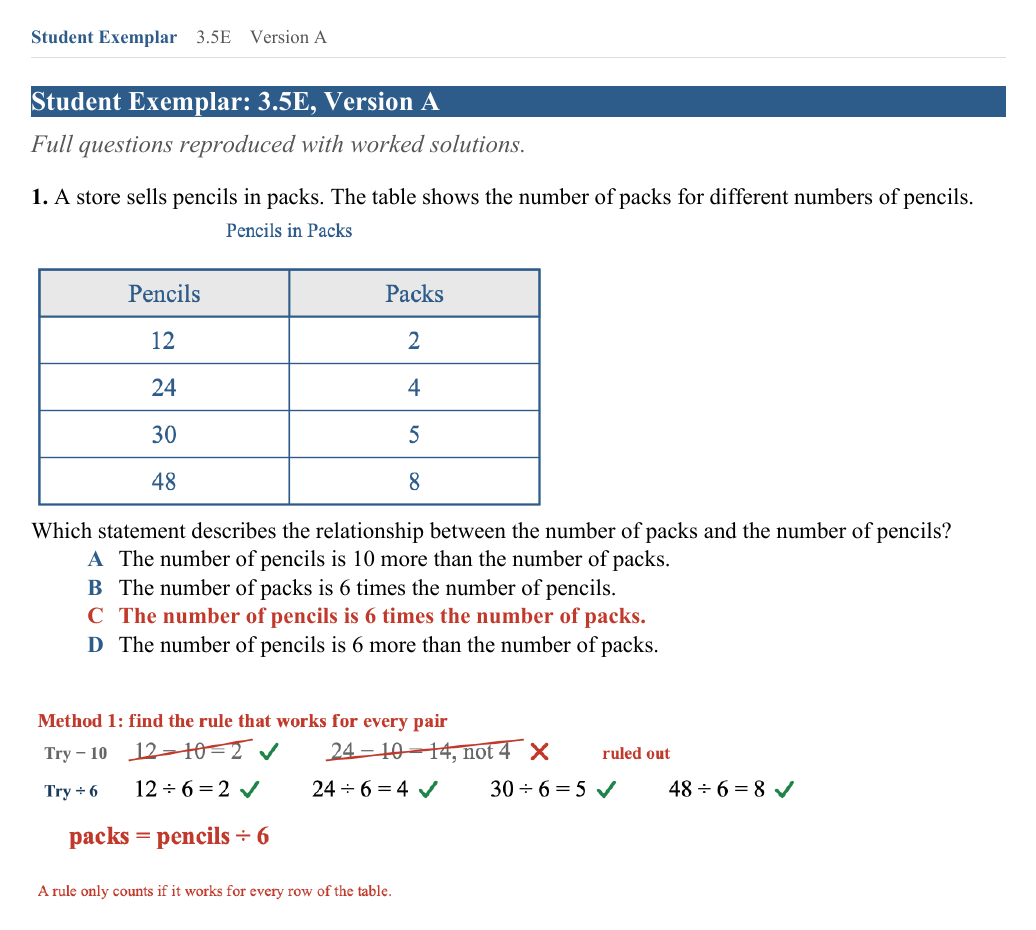
- Start with the first pair: 2 packs, 12 pencils. Adding 10 would give 12. So would multiplying by 6.
- Test both on the next pair. 4 packs: adding 10 gives 14, but the table says 24. Multiplying by 6 gives 24.
- Times 6 works on every row: 5 x 6 = 30 and 8 x 6 = 48. The pencils are 6 times the packs.
This is one way, not the only way. The printable shows the same question worked more than one way, because children get there differently.
What usually goes wrong, and what helps
Each of these is a different misunderstanding rather than a slip, so each one needs something different. Find the one that sounds like your kid.
- The student finds a rule that works on the first row and stops, instead of testing it on the rest of the table
- Try the rule on the last row of the table as well. A rule only counts if it works on every row.
- The student runs the rule the wrong way around, so the smaller column comes out bigger
- Ask which column holds the bigger numbers, then say the rule out loud in that order: the pencils are the packs times six, not the other way around.
- The student makes it an adding rule when the table is multiplying
- Ask what happens between 2 and 12, then between 4 and 24. Adding 10 works once; times 6 works every time.
Try this at home
Make a two-column table at the kitchen table: hands and fingers, or chairs and legs. Fill in two rows, ask for the rule, then test it on a row you have not filled in yet.
where these methods come from The strategies behind it: the Tables chart.
What’s in the printable
Four questions on this skill, two to a page. The rest of the file is for the adult: an answer key, a worked solution for every question, and teacher pages on what each wrong answer means.