TEKS 3.6C · Grade 3
Area of rectangles
Finding how many unit squares cover a rectangle, and seeing why the number of rows times the number in each row gives it.
The standard itself reads: “3.6C: determine the area of rectangles with whole number side lengths in problems using multiplication related to the number of rows times the number of unit squares in each row”
One of them, worked all the way through
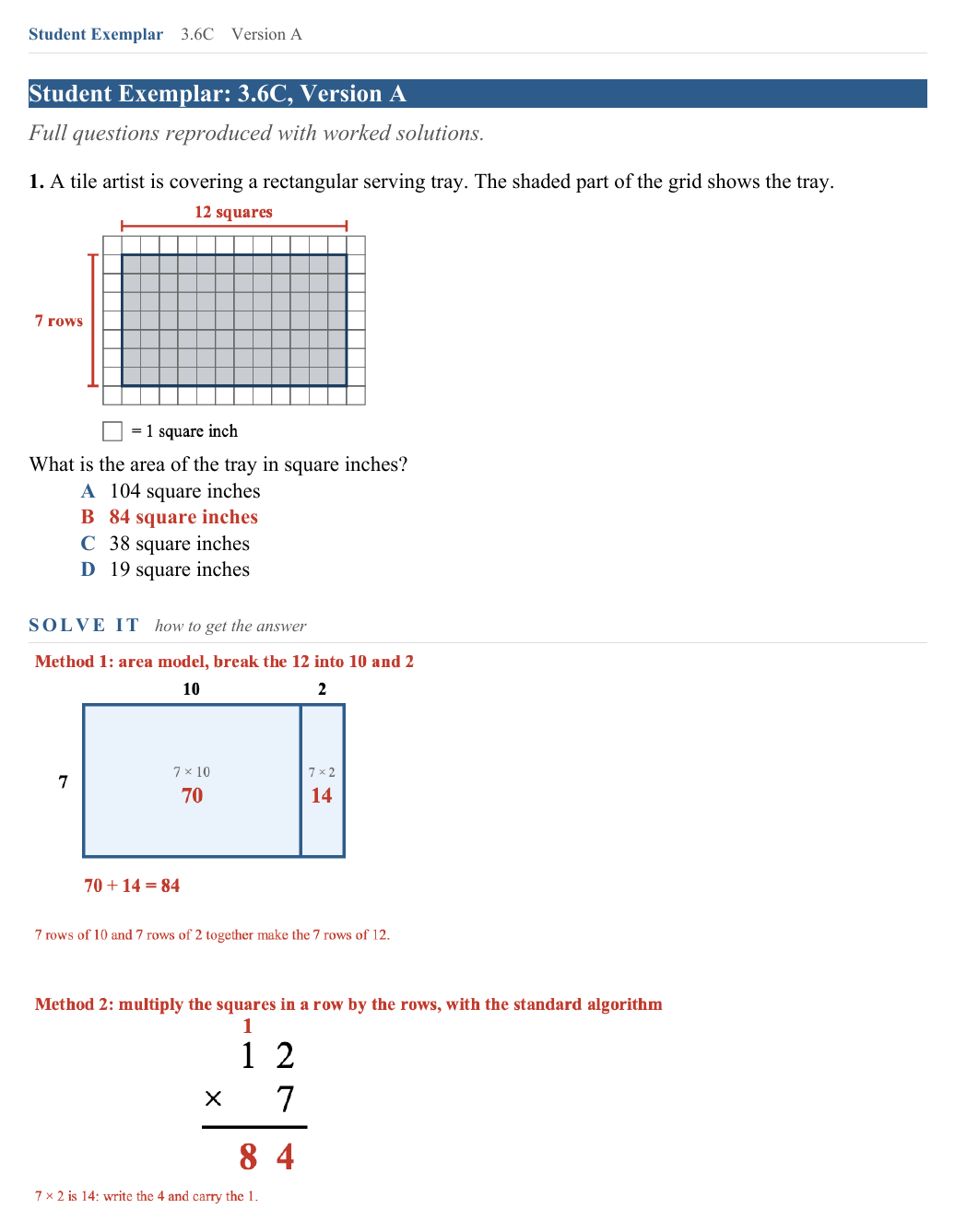
- Count the squares along one row, not the lines between them: 12. Then count the rows: 7.
- Break the 12 into 10 and 2. Seven rows of 10 is 70, and seven rows of 2 is 14.
- Put the parts back together: 70 + 14 = 84 square inches.
This is one way, not the only way. The printable shows the same question worked more than one way, because children get there differently.
What usually goes wrong, and what helps
Each of these is a different misunderstanding rather than a slip, so each one needs something different. Find the one that sounds like your kid.
- The student counts the lines on the grid instead of the squares between them
- Count squares, not lines. Put a finger on one square and ask how many fit across, then how many rows there are.
- The student adds the sides, which measures the distance around rather than the squares inside
- Ask what the question wants: the squares inside, or the distance around the edge. Area is the inside.
- The student adds the two side lengths once, so 12 and 7 give 19 instead of 84
- Have them skip count the rows out loud, 12, 24, 36, and hear how far one addition falls short of covering the tray.
Try this at home
Count the tiles on a floor or the squares on a chocolate bar. Ask how many are in one row, then how many rows, and let them decide whether to count every square or multiply.
where these methods come from The strategies behind it: the Area chart.
What’s in the printable
Four questions on this skill, two to a page. The rest of the file is for the adult: an answer key, a worked solution for every question, and teacher pages on what each wrong answer means.