TEKS 3.7B · Grade 3
Perimeter, and a missing side
Adding up the distance around a shape, and working backwards to one side when the perimeter is the thing you are given.
The standard itself reads: “3.7B: determine the perimeter of a polygon or a missing length when given perimeter and remaining side lengths in problems”
One of them, worked all the way through
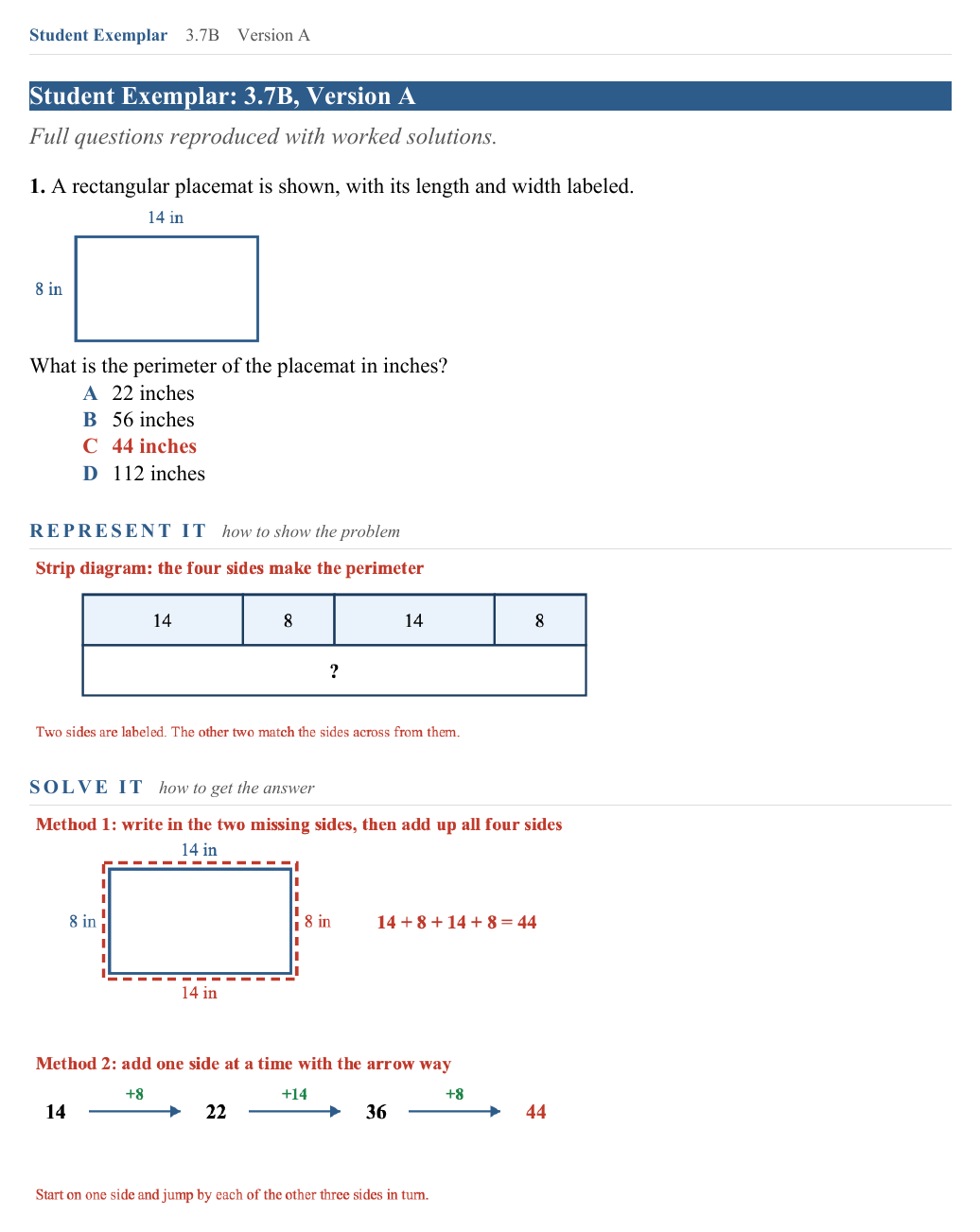
- Opposite sides of a rectangle match, so write 14 on the bottom and 8 on the other end before adding anything.
- Now walk all the way around: 14 + 8 + 14 + 8.
- That is 44 inches. Perimeter is the trip around the outside, not the space inside.
This is one way, not the only way. The printable shows the same question worked more than one way, because children get there differently.
What usually goes wrong, and what helps
Each of these is a different misunderstanding rather than a slip, so each one needs something different. Find the one that sounds like your kid.
- The student adds only the sides that are labeled and forgets the two across from them
- Write the two missing lengths onto the picture first. Opposite sides of a rectangle are equal, so nothing has to be measured to know them.
- The student multiplies the two sides, which finds the space inside rather than the trip around
- Ask whether the question wants the fence or the grass. Multiplying covers the inside; perimeter walks the edge.
- The student treats every side as the same length when only opposite sides match
- Ask which sides are the same. A rectangle has two pairs, not four of a kind.
Try this at home
Measure around something rectangular, a book or a placemat. Then cover one side with your hand and ask what it has to be, now that they know the trip all the way around.
where these methods come from The strategies behind it: the Perimeter chart.
What’s in the printable
Four questions on this skill, two to a page. The rest of the file is for the adult: an answer key, a worked solution for every question, and teacher pages on what each wrong answer means.