TEKS 4.2B · Grade 4
What a digit is worth
Reading a number written out in parts, such as (6 x 100,000) + (2 x 1,000), and saying what each digit is worth, including decimals.
The standard itself reads: “4.2B: represent the value of the digit in whole numbers through 1,000,000,000 and decimals to the hundredths using expanded notation and numerals”
One of them, worked all the way through
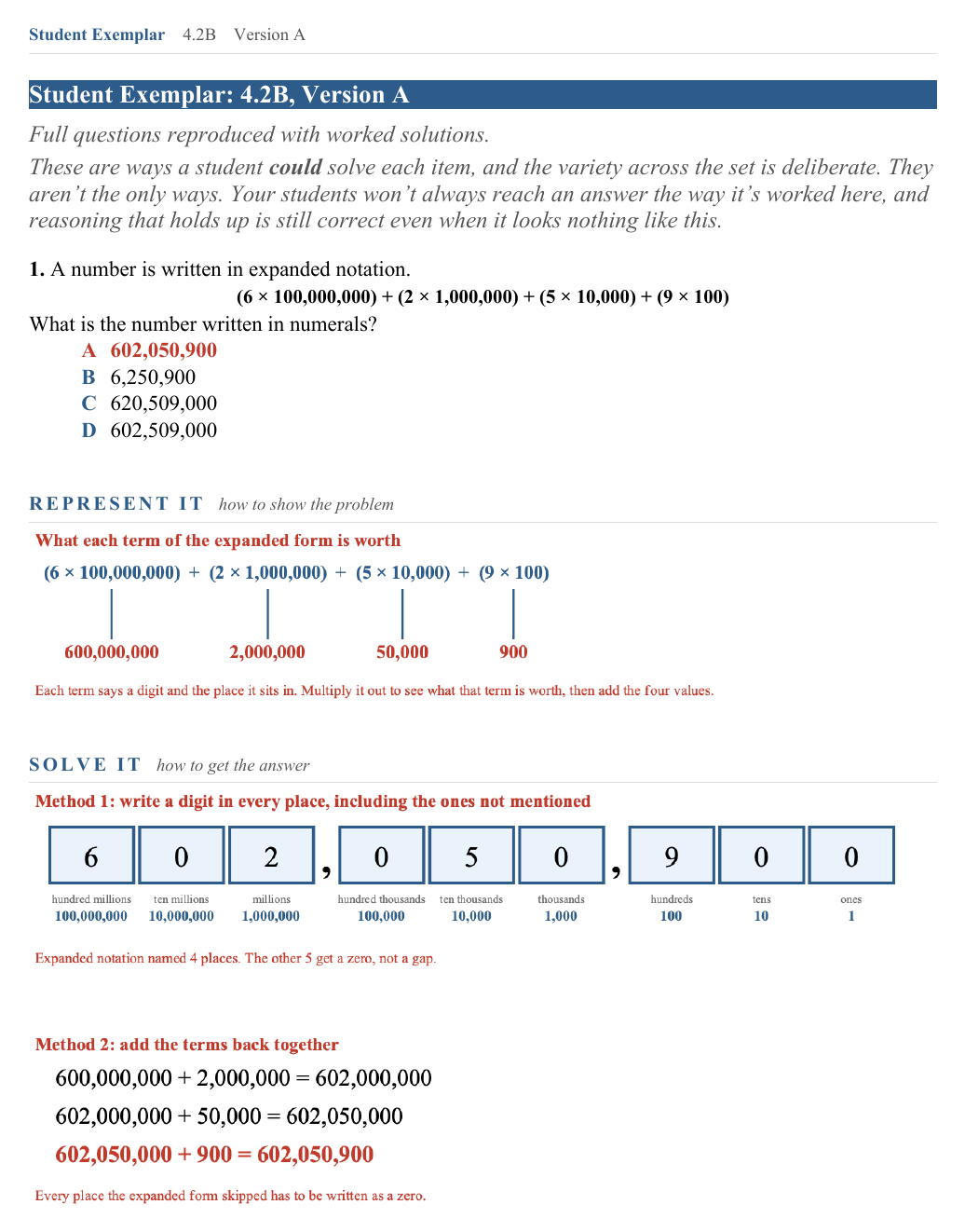
- Each piece names one digit and says where it sits. The 6 is in the hundred millions, the 2 in the millions, and so on.
- Put those digits in their places on a chart.
- Every place the expanded form never mentions is a ZERO, not a gap. That gives 602,050,900.
This is one way, not the only way. The printable shows the same question worked more than one way, because children get there differently.
What usually goes wrong, and what helps
Each of these is a different misunderstanding rather than a slip, so each one needs something different. Find the one that sounds like your kid.
- The student says the digit rather than what it is worth: “four” instead of “four hundred”
- Ask “what is that 6 worth?” rather than “what is that digit?” The answer is six hundred million, not six.
- The student skips the empty places when writing a number out from its parts, so every digit slides
- Write the empty places in as zeros before reading the number back. One missing place slides every digit to the left.
- The student counts the places after the decimal point from the wrong end
- After the point, count away from the point: tenths first, then hundredths.
- The student gives a zero a value of its own
- A zero holds the place open. It is worth nothing on its own, and it still has to be written down.
Try this at home
Point at a digit in a price or an odometer and ask what THAT digit is worth, not what the number is. The answer is always the digit plus the name of its column: 'four tenths', not 'four'.
where these methods come from The strategies behind it: the Place value chart.
What’s in the printable
Four questions on this skill, two to a page. The rest of the file is for the adult: an answer key, a worked solution for every question, and teacher pages on what each wrong answer means. 10 pages in all.